Legends of the Continent - Exploring African Mythology

If there's one thing most people have always wondered, it's what goes beyond European mythology. The exploration of myths and legends beyond the same old traditions is certainly a fascinating topic, because while they often capture significant attention due to their rich narratives and cultural impact across the world, interesting tales live freely far from the continent.
For instance, Asian legends include tales from cultures such as Hinduism, Buddhism, etc., presenting a complex combination of beliefs that shaped societies for centuries until this day. People usually come to learn about these through literature and/or oral traditions, broadening their understanding of the world's cultural heritage beyond their immediate environment.
It's important to note that African myths have gained more visibility and recognition mainly through the rise of social media. Before, these records weren’t widely discussed, but such platforms enabled a wider conversation about the diverse stories across African countries, emphasising their extraordinary value.
The Right Approach
Embracing new knowledge and maintaining an appreciation for traditional wisdom is crucial. By unifying and understanding the differences and similarities between cultures, everyone can gain valuable insights, contributing to a more comprehensive understanding of life’s complexities. I believe this is the right approach, a useful tool for piecing together the puzzle of human experience.
There are many reasons why some individuals lack knowledge in certain fields, and these can vary widely, but this is why it's essential to share insights from as many cultures as possible, especially since the African continent has a wealth of knowledge to offer.
After all, it's never too late to learn, share, and teach. One person’s story can have a unique and profound impact on another.
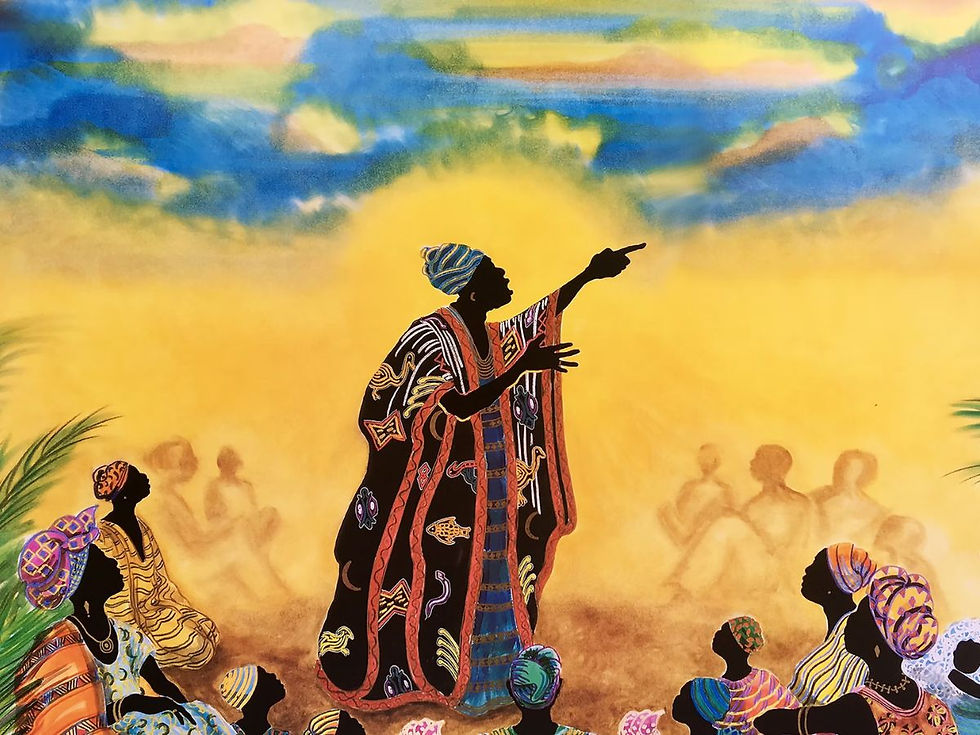
African mythology has primarily been passed down through oral traditions, and the myths are typically expressed as philosophical reflections, incorporated into rituals and practices passed down through generations.
If we can categorise European mythology into groups such as Norse, Greek, and Celtic, similarly, we should subdivide African mythology into distinct traditions such as Egyptian, Mali, Zulu, and many others.
Numerous cultures have been using griots (travelling poets, musicians, and storytellers), especially in West Africa, to preserve and share their folklore, but this shouldn’t be seen as a limitation; rather, it should help us recognise and appreciate their uniqueness.
West African mythology has one of the most notable deities: Anansi, a figure that straddles the line between a trickster God and a culture hero. His father is Nyame (the “Sky God”), on whose behalf Anansi brings rain, extinguishes fires, and performs various other tasks; his mother is Asase Ya, who’s referred to in several stories in relation to the children she bore.
And finally, in some myths, his wife is referred to as “Lady Anansi” or the “Witch Anansi”, although she is most commonly known as Aso.
Anansi is described as either a spider, a man, or a combination of both; for this reason, he is often called the “Spider” or the “Spider God”.
In some versions of the tale, he is credited with creating the sun, the stars, and the moon while teaching humans agricultural techniques. Others describe how he attempted to store all the wisdom of the world in a calabash (“Cucurbita lagenaria”, also known as “ornamental gourd”). However, he eventually realised that it was futile to keep all the wisdom for himself, so he decided to let it go.
In later versions, Anansi is depicted as a king.
Gbadu, Abuk, and Garang
West African culture continues to fascinate us with Gbadu, a goddess from the Dahomey tradition belonging to the Fon people, who live primarily in present-day Benin, Nigeria, and Togo.
Gbadu is distinguished by the dual nature of her lineage; both feminine and masculine, yet she’s predominantly referred to with feminine pronouns. This highlights the profound and complex nature of gender representation within this cultural narrative.
According to several legends, Gbadu is considered the “Goddess of Destiny”. Her myths are closely linked to the Ifa or Fa divination, originating in the Yoruba land. Furthermore, Dahomey folklore suggests that her descendants were responsible for teaching and spreading this practice among humans.

In Sudanese mythology, a lesser-known but significant record features Abuk and Garang as the first human beings on Earth.
Much of the available information primarily focuses on the woman, Abuk. She is seen as the patron “Goddess of women and gardens”, symbolizing fertility and nurturing. Her emblems include a small snake, the moon, and the sheep. Besides, she's also the mother of Denka, the “God of rain and fertility”, further highlighting her critical role in the legend.
According to the story, Abuk and Garang faced extreme hunger, as they were each given only one grain of food per day by the "creator". To make their limited food supply last, she creatively transformed that single one into a paste. She also made the decision to consume one grain every other day, with the intention of saving it for planting.
This clever approach led to her being remembered as the first person to cultivate, marking a pivotal moment in agricultural history.
Numerous tales within the African world warrant deeper exploration, and it's my intention to pursue them all soon. African literature and history don’t present uniformity, but rather gather diverse cultures and subcultures together, which interact and influence one another.
Like all things, there may be common themes floating around, but a careful exploration reveals a profound diversity and intricacy among each element. I suggest exploring more of this topic, since this is the best era to find and revisit different books and media.