Sherdana - A Glimpse into Sea Peoples’ Enigmatic History
- May 21
- 5 min read
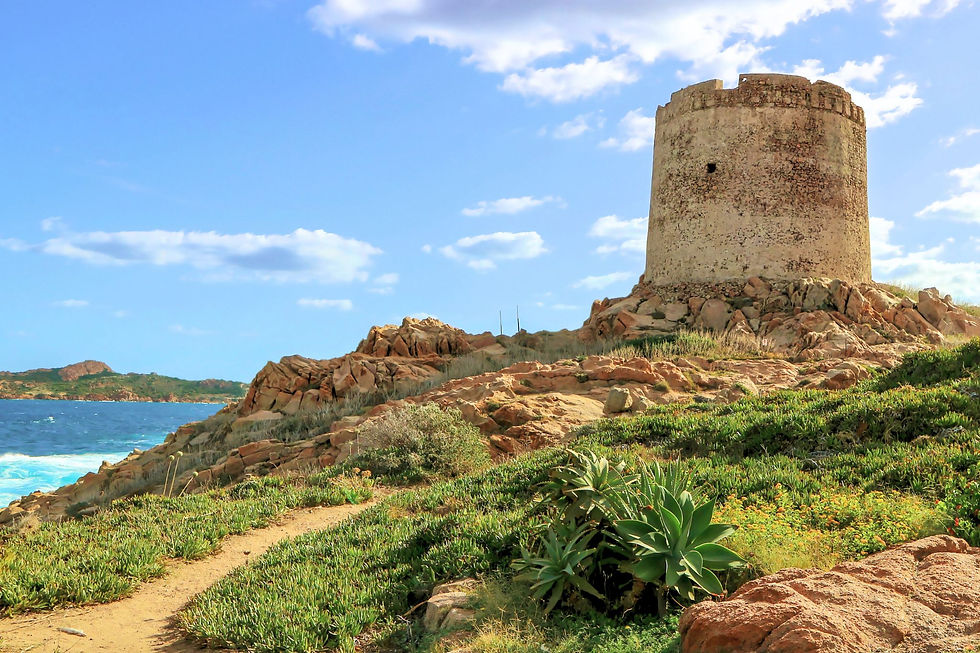
To truly appreciate the folklore and mythology that define a culture, sometimes we must first embark on a journey through its history.
This quest for knowledge inspired me to write this article: while it may be tempting to focus solely on the enchanting tales of Sardinia, I believe it's essential for readers to explore the deep cultural roots that shaped these stories.
To uncover the region’s ancient mysteries, we must start from Sardinia's first inhabitants: the Sherdana.
The Sherdana (English: Sherden, Egyptian: šrdn, šꜣrdꜣnꜣ or šꜣrdynꜣ), also known as the "Sea Peoples", were an ancient group believed to be the ancestors of the modern-day Sardinians, and played a significant role in historical maritime cultures.
Sardinia, one of Italy's two major islands, boasts a rich mosaic of cultures and traditions, reflecting its long history. Its residents date back to the Pleistocene era, which began approximately 2.58 million years ago and lasted until about 11,700 years ago.
Over the millennia, it has retained many aspects of its ancient heritage, making it a fascinating site for both artistic and historical exploration.
A Rare Kind of Strength
Despite being largely overlooked by time, it's crucial to revive and disclose the record surrounding these individuals. Their stories, woven with resilience and passion, deserve to be illuminated and passed on.
Historical evidence suggests that the Sea Peoples were a formidable group of tribes that launched significant attacks on Egypt and various regions of the Eastern Mediterranean around 1200 BC, during the late Bronze Age.
Egypt in particular, is identified as the key source of early information about them, with the earliest proof found in the reliefs located at the Mortuary Temple of Ramesses III in Medinet Habu.
The Sea Peoples included groups such as the Sherdana and Lukka, along with others of uncertain origins. An intriguing aspect of this topic is the absence of any archaeological evidence or historical records from Greece. This is impressive given Greece's documented contributions, both to its own narrative and to other civilisations' history.

The Sherdana were noticed in historical records from the time of Ramesses II, specifically in the context of a military conflict in his second year of reign, around 1278 BC.
During this period, they attempted to raid the coast of Egypt, but the Pharaoh claimed victory over them. Following this, he integrated many of these warriors into his personal guards, highlighting their significance in his military forces.
They also appear in the “Amarna Letters”, with their name rendered in Akkadian as "še-er-ta-an-nu". Some archaeologists have suggested identifying the Sherdana with the Nuragic civilisation of Sardinia based on onomastic similarities, weaponry, presence in locations around the Mediterranean, and their relationships with neighbouring Sea People.
Additional support for this theory comes from 12th-century Nuragic pottery discovered at Pyla-Kokkinokremos, a fortified settlement in Cyprus.
The correct pronunciation of their name, which aligns with ancient attestations, is "Sherdana", a constructed vocalisation. Egyptian documents didn't provide the possibility of fully vocalising the word; in fact, it was written exclusively with the consonants ŠRDN because Egyptian hieroglyphic writing is made up of ideograms. Therefore, the Egyptian term "Šardana" is nonexistent or incorrect.
The pronunciation of the first term is confirmed by Ugaritic texts discovered in the ancient city of Ugarit, located in present-day Syria, which was destroyed during the invasions of the Sea Peoples. The Akkadian language, used during that time, included three vowels: a, e/i, and o/u. In addition, there are also contributions from other studies.
An Enduring Enigma
Over the decades, various hypotheses have been proposed, with two being the most recurrent: The Sherdana came from the Western Mediterranean and could be identified with the Nuragic populations of Sardinia (including Corsica and Sicily).
They migrated from the Eastern Mediterranean and settled in Sardinia and neighbouring areas after the attempted invasion of Egypt.
Giacomo Cavillier, Egyptologist and head of the "Sherdana Project" at the Champollion Study Centre, has stated that based on the data collected, it's currently impossible to ascertain their origins.
This difficulty arises from their extensive interactions with several cultural regions of the Near East, including Ancient Egypt, Syria, Phoenicia, and the Aegean civilisations. Throughout history, the Sherdana adopted various cultural traits from these areas, which played a crucial role in their adaptation and survival.
Some scholars have suggested that the Sea Peoples originated from either Illyria or the Caucasus. Fritz Schachermeyr proposed that they came from Illyria, specifically tracing their roots to the Sardeates tribe of Dalmatia, which later migrated to Sardinia, giving the island its name.
However, this theory is a minor hypothesis and has less evidence to support it. In fact, the likelihood that they are connected to the Sardinian people appears much higher.

Sardinia dates its origins back to the Pleistocene era: the oldest human fossils from this time include those of the Protoanthropes, the first humans, identified by anthropologists as belonging to a group called Sinanthropus. This is remarkable, especially considering that the remains of Paleoanthropes, which include the Neanderthal Man, are from the Middle Pleistocene period.
These incredible individuals have therefore survived until today while preserving a distinct and deep past and culture. Today, they’re legally recognised as part of Italy, but still, the Sardinians' DNA reveals an intriguing divergence from the mainland Italians. And not only that: their multi-millennial isolation is unlike any other across all of Europe.
In addition to this, there's a treasure trove of captivating information about their language that traces its roots back to Proto-Sardinian, flourishing during the Nuragic era. This ancient tongue shares similarities with the Basque-Iberian Paleo-Hispanic languages and even with Etruscan.
The island of Sardinia is known for its language, featuring an incredible blend of numerous dialects, but it's also renowned for its undeniable beauty, characterised by outstanding nature and impressive architecture.
Besides, the island is steeped in intriguing folklore, including tales of Giants, ancient Dolmens that predate Stonehenge, and the Domus de Janas (homes of the fairies). All of this is an integral part of Sardinia's mythological heritage.
Furthermore, Sardinia holds an active community that continues to celebrate and maintain ancient traditions, with a growing wave of enthusiastic young people diving into the study of their language. This passionate attention not only keeps their culture alive but also honours the remarkable achievements of their predecessors, ensuring that their legacies endure through time.
While the echoes of their unique ancestors may have faded from the forefront of memory, there's always a devoted storyteller waiting to bridge the past and present, and together, they embark on a journey to trace the footsteps of the Sherdana, weaving their history into a story of memory and pride for its younger generations.
Having now completed our exploration of Sardinian history and culture, I am eagerly anticipating the next article: we’ll delve into the diverse folklore of the region that reflects the island's unique heritage and the beliefs of its people. I'm excited to uncover tales of ancient rituals, joyous festivals, and the symbolic significance of local customs that continue to shape the identity of the land to this day.