Whispers of the Hidden Fairies – Ireland's Enchanted Sidhe

Fairies, gnomes, and goblins are just a few of the enchanting and whimsical creatures that capture our imagination. From a young age, we've been captivated by stories woven with magic and wonder, whether they come in the form of fairy tales or nursery rhymes.
Across the globe, every culture boasts its own unique tales, rich with history and folklore- some imported from distant lands and others born from the creativity of local storytellers. Regardless of our origins, each of us carries a piece of this imaginative world within us, willing to share and connect through the narratives of these charming beings.
The general public is often familiar with tales of fairies and gnomes, depicted as mischievous yet benevolent creatures fascinated by humans. These beings are commonly portrayed as playful pranksters who, if approached with a good spirit, can form friendships with humans, offering gratitude in return.
However, the origins of these stories vary wildly across different cultures. Each country has its own unique narratives surrounding it, reflecting the diverse ways in which societies interpret their interactions with the mystical.
Different Traditions, Different Beings
For example, in Portuguese and Galician folklore, there are "Mouras Encantadas," beautiful but cursed maidens with long hair who typically guard places situated between the worlds, such as springs, dolmens, or enchanted stones.
It’s believed that, if you manage to break their enchantment, you'll be rewarded with gold, treasure, or even the love of the mouras themselves. However, if you fail, you'll lose the treasure, as well as the opportunity to win their affection. The Mouras are said to be the souls of maidens who once guarded a treasure or sacred place, and they are also known to be shapeshifters.

Among cultures, the Gaelic tradition features the most detailed stories with their Sidhe (pronounced: shee), known as the "fairy folk" or "little folk," which include various creatures.
Let’s start with the concept of "Aos Sí" (pronounced [iːsˠ ˈʃiː] Eess Shee; older form: Aes Sídhe [eːsˠ ˈʃiːə]; in modern Irish: Daoine Sí). This term refers to a supernatural race in Gaelic folklore, resembling elves. The Aos Sí are considered to be descendants of the Tuatha Dé Danann, a tribe of gods in Irish mythology.
The name Aos Sí translates to "Folk of the Sí" and they are believed to inhabit burial mounds, often referred to as fairy mounds, elf mounds, or hollow hills. These sites are thought to serve as portals to the Otherworld, which should not be confused with the Underworld.
The Otherworld is a distinct realm that exists alongside our own and intersects with our reality in certain areas. One of the most well-known gateways to the Otherworld is a cave located within the Rathcroghan complex in County Roscommon.
Not all of its inhabitants can be classified as fairies in the traditional sense. Technically, however, they could all be referred to as Sidhe if they traverse certain gateways. The Otherworld is an expansive and varied realm filled with diverse beings, each with their own roles and functions within this world.
Respecting Their Presence
It is said that fairies have the ability to interact with humans and the human realm. But the nature of the Sidhe remains ambiguous. Unlike Gods or ghosts, they're often regarded as entities that share similarities with humans but possess unique powers, characteristics, and attributes.
Even if the meaning of their names suggests noble qualities, one should not be deceived into thinking this indicates they have good intentions toward humans. These titles are respectful offerings given by humans who encounter them or are under their observation, so they may potentially leave them alone and unharmed.
These beings are far from the small, whimsical fairies often depicted in popular folklore. While some may be short in stature, others rise to tall heights, exuding an aura of charisma and authority. Their interactions with the human realm are varied and complex, often carrying significant consequences for those who dare to tread upon their sacred grounds or disregard their traditions.
In appearance, some fairies bear a striking resemblance to humans, while others possess distinctly humanoid features, can shift into animal forms, or are shapeshifters capable of manifesting in any guise they choose.
Although their attire may resemble typical human clothing, stories suggest that despite their attempts to blend in with us, there remains an uncanny sense of strangeness. Their garments often carry an antiquated or unusual flair, and their hair has an unsettling stillness; their skin might cast a bright glow or appear extremely dull.
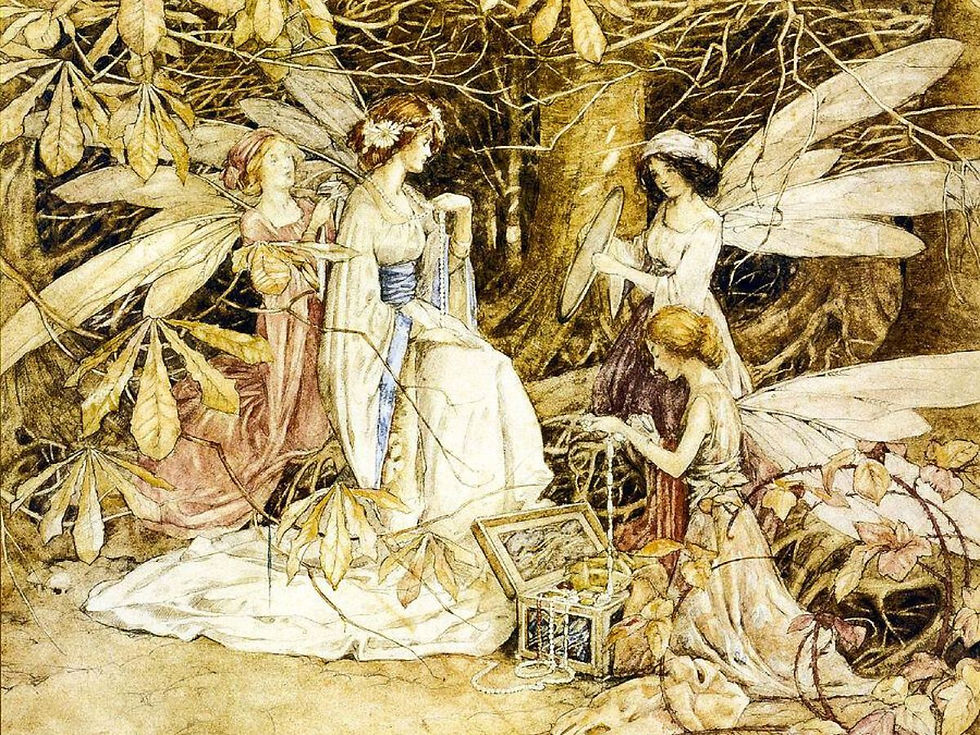
These creatures are also described as deeply connected to nature. They carry a deep relation to the earth, with many associated with natural landmarks, ancient mounds, hills, lakes, and sacred sites steeped in history. Each entity carries a tale woven into the very fabric of the land, serving as guardians of its secrets and lore.
It's widely recommended to avoid disturbing the dwelling places of the Sidhe, which include locations such as fairy forts, roads, fields, trees, rings, and mounds. These sites are often considered portals to the Otherworld, and disturbing them may lead to bad luck and the displeasure of the Sidhe.
Since they are closely connected to the land, they may communicate through environmental cues. Significant changes in weather, the rustling of leaves in a quiet grove, or unexplained sounds can serve as signs from these beings. Individuals are encouraged to pay attention to these signals and respond properly, often by leaving the area or performing a protective ritual.
It's also common practice to make an offering suitable to the environment before departing from an area. This ritual is believed to effectively discourage curious, angry, or idle fairies from following an individual home, as they can sometimes take an unusual interest in people.
The warnings about Irish fairies demonstrate the respect and caution the ancestors had for nature's forces and the unseen world. Many of us find comfort in stories, as they often resonate with our experiences and emotions. Among the countless fables shared in books and collections, here's one particularly famous tale:
«In Clifden, about sixty years ago, there lived a bagpipes player of no mean nature. He was in great demand whenever there was a marriage or a dance. He lived in a small cottage with his widowed mother. One night, he was coming home from a dance where he had been playing, and his pipes were under his arm.
All of the sudden, he heard music the like of which was never heard before. He listened, and after a few minutes, he could play the tune himself. He was just starting for home when he was confronted by a host of fairies. An imposing little man came from the front ranks and cried in a shrill voice: “If you play the tune you've just heard, you'll have to come with us”.
When the player reached home, he told his mother what had happened. So she told him to heed the warning. One night he was playing at a dance and began to play the fairy tune, and in one second, he had vanished up the chimney out of sight. His mother gave up all hope of ever seeing him again.

Continues,
About three miles from Clifden, there lived a wise woman who said she could free the widow's son from the fairy spell. One night she told the widow to follow her. After a long walk, they came to a grassy knoll and here the wise woman sprinkled the ground with holy water, said a few prayers, and the next minute the widow saw her son.
He had many things to tell his mother about the fairies. Every week he was taken by them to a football match. When the match began, he had to play on the bagpipes. He asked his mother how long he had been gone, and he was told six months, but he said he thought it was only one night.
There was a dance to celebrate his homecoming. He never told anyone outside his mother about the fairy tune. He lived fifty years after his adventure.»
The Schools’ Collection, Volume 0004, Page 072 – All of their Data © National Folklore Collection, UCD.
In today’s society, people still pay attention to the signs and seek to coexist peacefully with these creatures. Many records from different cultures remind us of the mysteries that extend beyond our comprehension, urging us to honour traditions and natural environments existing around us.
These stories not only captivate our imaginations but also resonate deeply within our souls, creating an invisible thread that connects us all.
They foster a deep respect for all cultures, particularly highlighting the rich heritage of Gaelic society, which teaches us the importance of living in harmony with nature and understanding our place within it.