Beneath the Surface: Unveiling the Myth of Hades and Persephone
- May 21
- 5 min read

Among the many ancient myths of the glorious Greek civilisation, the one that has resonated most with the modern era is undoubtedly the story of Hades and Persephone.
Persephone (in ancient Greek: Περσεφόνη), also known as Kore (Κόρη), meaning "young girl," is primarily remembered as the daughter of Demeter, the goddess who oversees nature, crops, and harvests. But she is also known as the wife of Hades, the God of the Underworld, which makes her both a minor Goddess and the Queen of the Underworld.
According to the main myth, she rules over the entire realm alongside her consort during Autumn and Winter. In contrast, in Spring and Summer, she returns to Earth to be with her mother, Demeter, causing the earth to flourish once again in her presence.
But Why this Division?
The words used and their transcriptions are crucial for understanding the original myth, which is now lost. This is why we rely on personal preferences or conjectures from other versions today.
In multiple modern interpretations, the two spouses love each other deeply and are portrayed as the "perfect couple", where one complements the other. Even when they argue intensely, it's ultimately because of their love for each other.
Unfortunately, it would require extensive studies, research, and a bit of intuition to understand how far from reality this myth actually is.
The only ancient source we can rely on dates back to the time of Homer; specifically, the myth is based on the Homeric Hymn to Demeter.
The Myth as a Lesson of Eternal Duality
In this text, the author explicitly mentions that Hades fell in love with Persephone to the extent that he sought advice from Zeus, his brother and her father. However, Zeus, who is not particularly known for his reputation with women, grants Hades permission to marry her, advising him to kidnap her and keep her eternally in the Underworld with him.
The long-awaited day finally arrived. Persephone was, as always, gathering flowers in the plain of Nysa with her companions, daughters of Oceanus. Among the vibrant blooms, she noticed an extraordinarily beautiful narcissus.
Captivated by its allure, she reached out to pick the flower, unaware it was a trap. Suddenly, a chasm opened beneath her, and Hades emerged, taking her to the Underworld to be his wife, despite her young age and against her will.

Once in the realm of death, she was offered some fruits, but she lacked the appetite to enjoy them and only consumed six arils of pomegranate. Little did she know- those who ate the fruits were doomed to remain there for eternity.
Here, we can delve into the symbolic meaning of fruits from multiple perspectives. Among them, the pomegranate stands out, most famously representing marriage and fertility in various cultural narratives. This vibrant fruit, with its jewel-like seeds, symbolises abundance and blossoming relationships.
However, other interpretations suggest that the true fruit may not be a pomegranate at all. Instead, some argue that opium, with its small yet strikingly similar capsule, holds that connection. The opium poppy, much like the pomegranate, possesses alluring qualities but is also renowned for its narcotic and psychotropic effects.
This parallel invites a deeper reflection on the contrasts between the nourishing, life-affirming attributes of the pomegranate and the darker, intoxicating allure of opium, which further sheds light on the woman's lack of consent.
The myth continues with Demeter, who, in her desperation, began to bring devastation to the crops, resulting in long, dark winters. Angered with Zeus, she refused to return to Olympus and transformed herself into an old woman. She then travelled to Eleusis in Attica, where she was welcomed by King Celeus.
With Zeus's intervention, an agreement was reached: since Persephone had not eaten a whole fruit, she would remain in the Underworld for a duration equal to the number of seeds she had consumed. This meant she could spend the remaining months of the year with her mother.
As a result, the young woman would spend six months with her spouse in the Underworld and six months with her mother on Earth.
Demeter joyfully celebrated Persephone's periodic return to Earth by making nature flourish again during Spring and Summer.
A Deep Analysis
This story aims to highlight and celebrate the cycle of the seasons. For the ancient Greeks, nature was rejuvenated during Spring- a season that, in many ancient calendars predating the Roman one, marks the beginning of the year.
For a better understanding, here are some fundamental parts of the Homeric Hymn to Demeter, in which the author clearly quotes:
«I begin to sing of Demeter, the holy goddess with the beautiful hair. And her daughter [Persephone] too. The one with the delicate ankles, whom Hades seized. She was given away by Zeus, the loud-thunderer, the one who sees far and wide. Demeter did not take part in this, she of the golden double-axe, she who glories in the harvest.»
Continues,
«He was riding on a chariot drawn by immortal horses. The son of Kronos. The one known by many names. He seized her against her will, put her on his golden chariot, and drove away as she wept. She cried with a piercing voice, calling upon her father [Zeus], the son of Kronos, the highest and the best.»
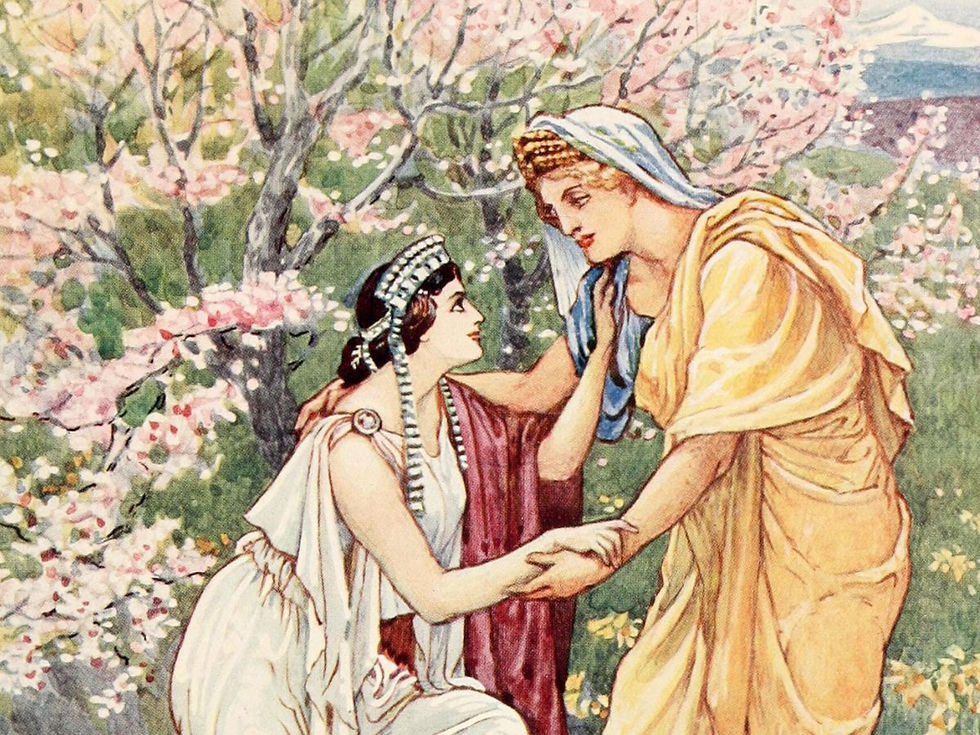
This is a hymn to all women, regardless of the era: women have never accepted subjugation- never before, and never will. Demeter's fury is not just a manifestation of desperation for her daughter; it is also rooted in frustration.
This frustration stems from her awareness of the civilisation in which she lived, where it was normal for men to act as they pleased while women were powerless to respond. It's a realisation that this was not the first time and would not be the last– just look at the myths surrounding Zeus to understand the cultural mechanisms at play.
However, as a mother and, above all, as a woman, she made her voice heard and brought significant consequences. She negotiated with Zeus only because she discovered a flaw in his and Hades clause- Persephone hadn’t eaten the entire fruit, and this was the most she could do within her role as a woman.
It didn’t matter that she, too, was a Goddess in their realm; this was her reality, as well as that of her daughter and many other women.
So, what is so different from modern society? Aside from having a few more laws and some common sense in certain situations, this remains a relatable story.
It's painful, but it raises awareness.
The myth of Persephone is a story woven with countless interpretations, inviting us to explore its depths. Yet, beneath the layers of complexity, its essence might be more straightforward than we realise. The thoughts and emotions of ancient minds often mirror our own contemporary struggles and insights.
Imagine embodying the unwavering strength and fierce love of Demeter, a mother whose resolve shines brightly even in the face of despair. Picture Persephone, who, despite her harrowing journey to the Underworld, holds onto hope and learns to trust, overcoming the shadows of her past.
If we all embraced such resilience and optimism, choosing to foster hope and connection despite life’s challenges, we could transform our world into a far brighter and more compassionate place.
